Wednesday, January 9, 2013

To Train or Not To Train...

Canine conditioning and rehabilitation.  A very interesting subject and one I intended to write about after attending a seminar by Dr. Maria Glinski.  That was BEFORE my Aussie, Abby, got hurt.  This subject has a whole new meaning when you have a dog who is injured.

First, a little background.  Abby is a CRAZY Aussie (is there any other kind?).  She likes to vault off the couch at home and chase her brother, Rascal, at full speed whether we are inside or outside.  When at agility there is no off switch.  She likes to do teeter fly offs and crash into jump bars.  We have been fortunate that she has been healthy.  Before the last trial, however, she had a limp.  She recovered for the trial and I ran her with no problems.  A few weeks later she had a severe limp after a hard training session.  She wasn't painful or swollen anywhere I touched her and the limp went away.  I decided we needed to figure this thing out.  So we stopped training and tried to make her rest - eventually that meant drugging her with Benadryl in the morning to keep the couch vaulting to a minimum.  After some rest we started small frequent walks for strengthening.  After 3 weeks we have started gentle stretching to make sure it didn't worsen any possible muscle tears.  We are currently in a holding pattern until her appointment with Dr. Maria Glinski who specializes in physical therapy for animals.  

Being a physical therapy student I have my theories about what is wrong with her.  But it gets you thinking about how much stress is put on your dog during agility.  Most trainers will wait til their dog has a problem and then fix it - myself included.  This is exactly how we treat our own bodies.  We need to switch our focus to become proactive instead of reactive.  What does this mean?

1. Dynamic stretching of your dogs before exercise.  Basically this is just warming them up - do some spins, downs, etc.  Save the static stretching (holding a stretch for 20+ seconds) for after exercise.  

2. Include walks or runs as a part of your training.  Not only will it be good for your dog, but you could stand to burn some calories too :)  
***Any interesting side note: Abby's problem didn't start until I was no longer running with her because I was no longer training myself for triathlons.  Her injury may have been prevented if she had more walks or runs.***

3. Take your dog swimming!  Wag N Splash in Charleston, SC offers a facility open year round.

4. Tug with your dog - it's great for their strength.

5. Look into buying a balance ball for your dog.  It will strengthen their core and stabilizing muscles.  Their ball can double as exercise equipment for you!!  Here is my personal favorite:
http://www.cleanrun.com/index.cfm?fuseaction=product.display&product_id=2140&ParentCat=400&string=balance%20ball

6. Let them rest.  Sometimes you need to take a break from training.  All athletes have an off season.  Summer in Charleston is hot so I take it easy then.

As a final note you probably noticed little tips for training yourself as well.  Your dog is important, but remember to be proactive with your body.  You can't run your dog if you are hurt.  I do simple exercises 4-5 times a week to help with knee pain.  Keep in mind that physical therapists specialize in movement dysfunction (you can tell I'm a PT student, right?).

Happy strenghtening and stretching!

Lindsay Shuler
Rascal and Abby

Tuesday, November 27, 2012

BowWowFlix


We all know that dog training DVDs can be pretty expensive. We have a great selection of books and DVDs in the LCDA library, but occasionally I cannot find the book/DVD that I am looking for. While looking for a better price for a tricks training video that I wanted, I found this website:


Bow Wow Flix has an inventory of thousands of DVDs about dog obedience, agility, tricks training, breeding, grooming, etc. You pay a monthly fee of $10.95 and you can rent an unlimited number of DVDs per month. As soon as you are done with one DVD, you ship it back (shipping is free both ways) and get your next DVD in the mail, similar to Netflix. You can cancel your subscription any time you want. So instead of having to pay $60 for the tricks training DVD I wanted, I am now only paying $10.95. I browsed through the agility DVDs and they had a great selection including videos by most of the lead trainers we're all familiar with like Susan Garrett, Linda Mecklenburg, Susan Salo, and Rachel Sanders.

Enjoy!

Christine and Rusty

Wednesday, November 7, 2012

What Does Your Dog See?


As a veterinary ophthalmologist, I am frequently asked questions about the specifics of vision in dogs, especially performance dogs. Vision depends on a number of factors, but there are some important concepts common to all dogs. These concepts are often most easily understood in a comparative fashion to our vision.


Field of vision: Dogs have a wider field of vision based on the more lateral position of the eyes. Compared to humans who have about 180-200 degrees, a dog’s vision field is 240-270 degrees, meaning that their peripheral vision is much better than ours. This allows our dogs to run ahead of us and yet still be able to detect our pace, body position, and arm motions when we are behind and lateral to them. This also gives them much more in the way of obstacle options from which to choose compared to what we are focusing on, so our body position needs to assist in accurately directing them.

Detail vision: The advantage of the wider field of view in dogs results in a compromise in binocular vision. This results in decreased depth perception and a decrease in focusing/accommodation or detail vision. In comparison to the average human with 20/20 vision, the average dog has 20/75 vision (the detail that we see at 75 ft, they see at 20 ft).  This means that from a distance they cannot see facial expressions or an object at rest. So frowning at your dog is not perceived! This loss of detail is outweighed by their ability to see much better in dim light and to detect motion.

Color: Dogs are NOT color blind. They are similar to a human with red-green color blindness in that they do see SOME color. Specifically the canine retina contains 2 cones (versus 3 in humans): one at 429 nm (blue) and the other at 555nm (yellow). They can easily differentiate colors in these wavelengths similar to humans. They lack a red type cone, so red/orange/green are seen as shades of yellow.  From an agility equipment standpoint, blue and yellow are easily distinguished which is why most contact equipment in competition involves these contrasts.  The dark green and yellow are contrasted well enough to be distinguishable.

Night vision: The dog’s retina is rod-dominated, and rods are responsible for dim light vision. They also have a reflective structure within the retina that reflects light (tapetum). Because of this, dogs (and cats) can see much better than humans in dim light. Training at night is much harder for us than for them!

Motion: Rods are also responsible for motion detection. With a rod dominated retina and a wider field of view, dogs are MUCH more sensitive to subtle motion changes than humans are. This is why a flick of the hand can be so distracting and can cause a knocked bar or a sudden pull out of a tunnel. A subtle change in our pace (acceleration/deceleration) is very notable to them as well.

I hope that this improves some understanding of how your agility dog visualizes the equipment and the handler. Even with this abundant knowledge, I still flick my hand or adjust my sunglasses while my dog is weaving.

Anne Cook and Hunley


Thursday, November 1, 2012

Team Competition

Yes, I know - you've heard enough about if you and your dog are a team.  But wait!  This blog is actually about the team event at agility trials.  Rumor has it we will be offering team in a spring trial.  So, you should know a little something about it before you compete in it.

USDAA Dog Agility Masters (DAM) Team/ Performance Versatility Team (PVP)

-Open to any level dog/handler.
-Championship Teams have 3 dogs/3 handlers; Performance Teams have 2 dogs/2 handlers.
-Championship Teams can have only 2 different heights; Performance can be any heights.
-You can enter with a team, or if you don’t have anyone to enter with you can enter as a draw and you will be put with a team.
-You get to pick the name for your team!
-Each dog/handler competes in each of the 5 classes (Standard, Gamblers, Jumpers, Snooker, Relay)
-Courses are Masters level with a few differences - no table in Standard, may be different rules for Gamblers, Snooker may be modified, Jumpers has weaves & long jump.  Judges can get more creative.
-Each person is scored individually and scores are added together for the team; Each class is given a specific number of points.
-Classes are scored under Masters Rules, Time + Faults, ie faults such as dropping a bar/missed contact/refusals are added to your time.  3 refusals, taking an off course, or skipping an obstacle give you an E for that class.
-You don’t qualify/place in individual classes (your individual runs don’t count for titles); Teams qualify by earning over 850 points total in Championship (566 for Performance) or within 25% of the average of the points of the top 3 teams overall.
-Team Qs are needed for your ADCH, Tournament Master title, or to qualify for Nationals (2013 USDAA Nationals are in October in Murfreesboro, TN - you need 1 team Q to enter team at nationals).

There you have it.  Are you excited for team now?  Happy Trialing!

Sunday, September 9, 2012

Judy Reilly Seminars


Judy has been involved in dog sports for over ten years. Originally from Long Island, NY, Judy has always shared her life with dogs and horses. Currently living in upstate NY with Husband DJ and 15 yr old Son Nick, and employed at Animal/Equine Health practice, a holistic veterinary practice in Litchfield CT, Judy Found Agility after taking obedience classes with Tia her German Shepherd.  Tia went on to earn her Novice titles in Agility and Obedience and even earned some flyball titles. In 2003 Judy became a USDAA judge and in 2009 went for Masters certification. Judy can be found anywhere in the country either Running her dogs or Judging. Judy Also teaches Class at Canine Sports Center in Goshen CT and Paws n Effect in Hamden CT, Using positive methods and helping the handler and dog work together to negotiate any course to the best of their ability.


"Tia", a rescue German shepherd, was her first Agility Dog, (July 1994-Feb 2007). Although she did not gain many titles, Tia was a great teacher for Judy competing in agility and obedience and, at age nine, learned flyball.

"Brodie", retired 14 year old border collie, also competed in agility, obedience and flyball, earning his ADCH in fall of 2003. --Brodie  He spent his last few years being run by Judy's Son Nicholas before being retired in the fall of 2009.

"Sony", a 9 year old border collie, also runs agility and flyball. She earned her ADCH one month after her third Birthday. In 2006 she was a Grand Prix finalist at the USDAA Nationals in Scottsdale, AZ, in the very competitive 22-inch class.in 2011 after missing 3 nationals events in a row due to injuries/surgeries she came back to be a PGP Finalist in KY in the 16" class. Most recently winning the PGP finals at the SE regional in Perry GA  She has earned many placements in national and local tournament events.

"Lotus", a high drive black German shepherd, joined the Reilly crew in May of 2006.  Judy spent time building a relationship with Lotus, letting her "grow up" since she was slow to mature. She currently Competes at the ADV/Masters Level.

"Rivet", born in June 2007, is a female border collie Judy could not say "no" to, even though it meant having two young dogs to train.  Rivet Earned her ADCH in the Spring of 2011 , Has also placed at National and Local tournament events. and when possible enjoys playing Flyball as the anchor dog for "Moonspinners" Flyball Team.
  
Just to add a little mix to the household in March of 2012 "Tempest" a Border/Jack became part of the crew. Born on Superbowl Sunday this little dog is a lot of energy in a small package, eager to work, play, eat and sleep.

Judy has worked with Many top trainers including Mary Ellen Barry, Jen Pinder, Rachel Sanders, Susan Garret Dana Pike ,Barb Demscio , Stacey Peardot-Goudy , and Ann Eifert of Hungary

Judy Reilly will hold the following group seminars at the LCDA training field on October 27 and 28:

  • October 27 (Saturday) will be open to beginner dogs who have not yet earned a Starters title in competition.
  • October 28 (Sunday) will be open to advanced dogs who have earned at least one Starters title in competition.

The seminar will begin at 8:30 am and last about 8 hours.
The cost will be $100/per day. 

Visit www.lowcountrydogagility.com for more details and to register.


Sunday, September 2, 2012

Tugging with a Reluctant Tugger


My Boykin, Rusty, loved to tug at home. However, when we got to the field with lots of people, other dogs, weird smells, and loud noises, he wanted nothing to do with a tug toy. Although it isn't necessary to have a dog who loves to tug to do agility, it is definitely a good tool to have. Tugging can be used to get a dog excited before a run, to build your relationship with your dog, or to use as a reward while training. 

I found the perfect toy for my reluctant tugger, a treat pouch. A treat pouch is a small bag with a velcro closure along the top and a handle for tugging. These pouches come in many different designs.  You cannot expect your dog to naturally start tugging with the pouch, you must teach him how to tug with it. 

It is important to start out in a place that is very familiar to your dog. The agility field is too stimulating to begin tugging, so start at home. Pick a room that your dog spends a lot of time in. Never push the toy in your dog's face, this will not make him want the toy. You may want to keep your dog on a leash for the first few play sessions, so he cannot run off.

Start out by filling the toy with your dog's favorite smelly treats. Open up the pouch and let him eat some of the treats so he knows what's inside. Close the pouch. Make the pouch come "alive", by moving it quickly along the ground and use an exciting tone of voice.  If the dog shows any interest in chasing the pouch at all, open it up and let him have some treats.  Continue rewarding the dog for any interaction with the pouch for a couple of play sessions.

Once your dog is interested in the pouch, you can start holding out on rewarding until their mouth makes contact with the toy. Start by rewarding your dog for grabbing the pouch for 1 second, then increase the time he/she has to hold on to it (3, 5, 10 seconds, and so on). As your play sessions continue, hold out longer to reward.

After your dog is grabbing hold of the pouch for several seconds, you can start to pull on the other end. Only tug on the pouch for a few seconds and then quickly open the pouch and reward.  Eventually your dog will understand that he must tug with you to get the treats inside of the pouch. While playing tug, remember to allow your dog to "win" sometimes, so he does not get discouraged.

Once your dog loves to play tug with you at home, you can begin to play in other locations. For example, after Rusty loved his toy in the living room, we tugged in my backyard, and then finally at the agility field.

Here is the Clean Run web page with all of the different treat pouches:

Here is the one Rusty has:

Christine and Rusty

Thursday, August 23, 2012

Using The Tip Assist To Improve Teeter Performance

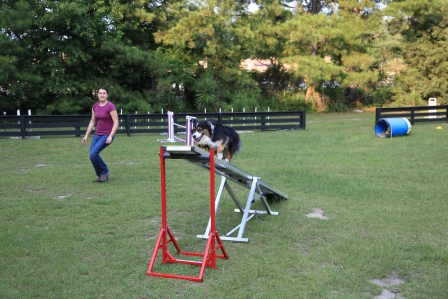
Many of you have probably seen my Aussie, Leila, joyfully launch herself into the air off of the teeter long before it reaches the ground.  Even though she finds this to be the most fun way to perform the teeter, agility judges don't agree :)

After trying various things in an attempt to convince her to ride the board to the ground, I was at a loss for what to do. Unfortunately, most articles and videos that explain methods for teaching the teeter focus on building the dog’s speed and confidence on the obstacle. Obviously, this was not Leila’s problem. She has no shortage of speed and confidence on the teeter ;) Very few resources addressed my problem: the over-confident dog.

When Lynne Stephens came to give a seminar in May and showcase her new teeter training device, the Tip-Assist, I was very interested. Finally, a piece of equipment that would allow me to reward her for staying on the teeter while it is in the air without having to hold the board myself or use potentially dangerous things to hold it up. Below is a basic synopsis of teaching or retraining the teeter using the Tip-Assist.

First Things First 

Have a mental picture of your dog’s final teeter performance before you begin. Ideally you want the dog to run to the end of the plank, ride it to the ground, and then assume his end position

Work on some foundation exercises to increase the dog's speed, confidence, and independence before you begin working with the actual teeter. Things to work on include getting the dog comfortable on a boggle board/moving surfaces, plank work, targeting, shaping games, teaching a release word, and making sure that the dog is not afraid of loud noises

Now you're ready to begin training in the Tip-Assist.

Using the Tip-Assist

Step 1
  • Start the dog by allowing him to hop onto a low, stationary board.
  • Set the Tip-Assist on #16 and place it under the ground end of the teeter, moving it as close to the center of the teeter as possible. This should place the ground end of the teeter a few inches off the ground and not able to move. (see photo below)

  • Wrap the dog around your body and have him hop onto the side of the board and walk into a 4-on position at the ground end of the teeter. The teeter board should not have moved and the dog should be standing as close to the edge of the elevated board as possible. (see photos below)

  • Reward the dog heavily for staying in position (food is much easier than using toys), then lift him to the ground.
  • Once the dog is happily hopping onto the board and waiting in position to be rewarded, you can move to step 2.
Step 2

  • Teach the dog to ride the board down a few inches.
  • Leaving the Tip-Assist on the same end of the teeter as the last step (the ground end), raise it up to #4. This time you will be working on the opposite end of the teeter. What is usually the “up” end of the teeter should now be 4-6 inches from the ground and will move when the dog jumps on it. (see photo below)

  • Wrap the dog around your body and hop onto the side of the teeter. Have the dog ride the board down and move into his end position (either 4-on or a 2on-2off on the ground.)  (see photos below)


  • Heavily reward the dog and give him his release word. Because the board moves a few inches at this stage, the dog may take more time to get comfortable with this step. You do not want to move past this stage until the dog is completely confident hopping on and riding the board down a few inches. If the dog is having a lot of trouble with the motion, move the Tip-Assist in more towards the center of the teeter to lower the end.
Step 3

  • Place the Tip-Assist under the up-end of the teeter at #1 or #2 so that the board does not move. (see photo below)
  • Hold the dog on leash and walk him up the stationary board (the same way he would go up if he was going to perform a normal teeter.
  • Reward the dog when he is all the way at the end of the board in a 4-on position. The board should not move at all when the dog walks up. (see photos below)

  • Lift the dog onto the ground.
  • Allow the dog to increase speed each time he goes up the teeter, removing the leash when he is confident. You eventually want the dog to be running full speed up the board and waiting to be rewarded at the very edge of the up-positioned board. (see video #1 below)

Proofing Performance

Before lowering the Tip-Assist, start proofing the teeter performance. You want your dog to do the teeter independently right away.
  • Vary handler positions and handling each time, adding things such as a front-cross, rear-cross, running past, hanging back, staying close, getting lateral distance, and running at different speeds. Your motion should not affect the dog’s performance. He should confidently drive to the end of the teeter and wait to be rewarded no matter what you are doing. (see photos below)


  • Add obstacles before the teeter to increase the dog’s speed and excitement, and create a more trial-like environment. Rev your dog up and use high value rewards to keep the dog motivated and excited about the game.
Improving performance

Once the dog is confidently completing the stationary teeter with the proofing exercises, you can move the Tip-Assist down one number so that the teeter has a slight drop. (see photo and video below)


If the dog is afraid of the tip, make the drop even smaller by moving the Tip-Assist in towards the center of the teeter. Even though the teeter is now dropping, you still want the dog to run all the way to the end of the board before he is rewarded. The dog should not be stopping at the tip point. Do many reps with various handling/sequencing patterns at each number before increasing the drop. Do not move forward if the dog shows any type of hesitation. Remember your ideal teeter performance that you pictured at the start of the training (see the first bullet in "First things first" above)!

Continue to lower the board until it is dropping all the way to the ground. Once the teeter is falling to the ground, make sure to reward the dog in whatever end position you have chosen (4-on or 2on-2off) and give your release word before you allow the dog to move.

See the Results!

After working with Leila using the Tip-Assist since mid-May (about 2 weeks), we have just this week made it to the stage where the teeter is falling to the ground. We have not had many opportunities to test her new performance, but from the few repetitions we have done, I have been very pleased with her teeters. Her performance is not yet exactly how I would like it, but there is significant improvement. She is no longer flying into the air, and with my crazy girl that is a major victory. We still have another month to work on her teeter performance before I go back to school and lose access to equipment, so I will continue to proof her teeters, adding as much speed as possible to reinforce her holding onto the board even when she is excited. Training using the Tip-Assist has been very fruitful for Leila and me, and I would suggest that anyone experiencing teeter problems to give it a try.

Good Luck!

Courtney Hoslcher
Leila and Sandy